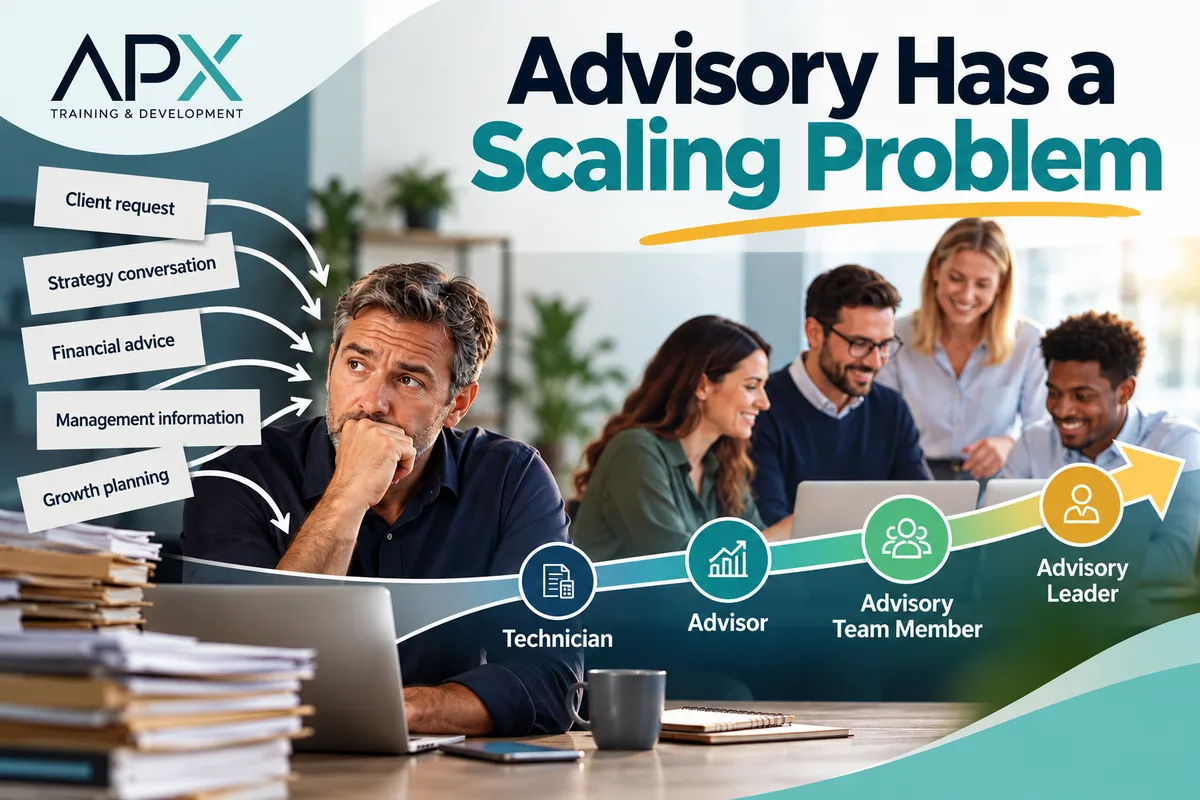
Advisory Has a Scaling Problem: How to Build Advisory Beyond the Practice Owner
Advisory Has a Scaling Problem
Advisory has become an important growth area for accounting and bookkeeping practices.
It gives firms an opportunity to move beyond compliance, deepen client relationships and have more meaningful conversations about what is actually happening inside a client's business.
But advisory has a scaling problem.
In many practices, advisory starts with one person.
Usually, it's the owner, partner or most experienced member of the team.
They're the person who develops the deeper client relationships. They understand the story behind the numbers. They know which questions to ask, how to challenge a client's thinking and how to turn financial information into a useful commercial conversation.
And, naturally, clients begin to rely on them.
That can work extremely well.
Until you want to grow it.
When successful advisory creates a bottleneck
The problem isn't that the advisory service isn't working.
Quite the opposite.
The problem often appears because it is working.
More clients want advisory. Existing clients want more support. The practice sees the opportunity to increase the value it delivers and build recurring advisory revenue.
But if every advisory conversation, decision and client relationship still depends on the same person, growth simply creates more work for them.
Their diary fills up.
They become the person everyone needs to speak to before something can move forward.
The team may be perfectly capable of producing the accounts, reports and management information, but the owner is still expected to interpret it, present it and lead the strategic conversation.
Eventually, the advisor becomes the bottleneck.
And there's a limit to how far that model can scale.
Advisory needs to become a team capability
At APX, we believe the answer isn't simply to make the owner more efficient.
It's to build advisory capability across the practice.
That doesn't mean expecting somebody who has spent their career as a technician to suddenly walk into a client meeting and become an experienced advisor.
It means developing people progressively.
A technician can begin by understanding the numbers they're producing in a different way.
Instead of simply asking:
Have I produced this correctly?
They can begin asking:
What are these numbers telling us?
From there, they can develop the confidence to explain what they're seeing, ask better questions and contribute to client conversations.
Over time, those skills can develop into the ability to lead financial strategy conversations themselves.
From Technician to Advisor
Moving from technician to advisor isn't about abandoning technical skills.
Those skills provide the foundation.
The shift is in learning how to use financial information to help clients understand their business and make better-informed decisions.
That includes developing skills such as interpreting financial information, identifying patterns and risks, asking effective questions, explaining financial concepts clearly and having commercial conversations with clients.
And importantly, these skills can be taught, practised and developed.
Advisory doesn't have to remain something that only the most experienced person in the practice knows how to do.
From individual advisor to advisory team
Developing individual advisors is only part of the answer.
If each advisor works completely independently, you can simply create several smaller versions of the same bottleneck.
Sustainable advisory requires collaboration.
Different members of the team will have different strengths, experience and client knowledge. When those skills are brought together, advisory becomes something the team can deliver collectively rather than something that depends on one individual.
People can contribute at different stages of their development.
A newer team member might identify something in the numbers.
A more experienced advisor might explore it with the client.
Another member of the team might support the implementation of the strategy that follows.
Advisory becomes a way the team works together.
And that changes the role of the practice owner
For many practice owners, this is the biggest shift.
Their role gradually moves from being the person who does all the advisory to the person who develops the people and systems that allow advisory to happen without them.
That's a very different kind of leadership.
It means creating clear processes, developing the team's skills, giving people opportunities to participate in client conversations and gradually transferring responsibility.
Not throwing somebody into the deep end.
Not handing over an important client relationship overnight.
But deliberately developing capability, one conversation and one strategy at a time.
The APX development pathway
This thinking sits behind the APX development pathway:
Technician → Advisor → Advisory Team Member → Advisory Leader
Each stage develops a different capability.
The technician develops the financial understanding and confidence to move beyond simply producing the numbers.
The advisor learns how to interpret those numbers and turn them into meaningful client conversations and financial strategies.
The advisory team member learns how to collaborate with others so advisory can be delivered as a team.
And the advisory leader learns how to develop that capability across the practice — without remaining at the centre of every client relationship and decision.
Because sustainable advisory isn't about creating one brilliant, indispensable advisor.
In fact, if the success of your advisory service depends entirely on one person, you've simply created another dependency in the business.
The real opportunity is to build the skills, confidence, financial understanding, processes and leadership capability that allow advisory to be delivered across the practice.
Build the capability. Build the team. Remove the bottleneck.
Find out more about APX and how we develop advisory capability across accounting and bookkeeping practices at apxtraining.co.uk.