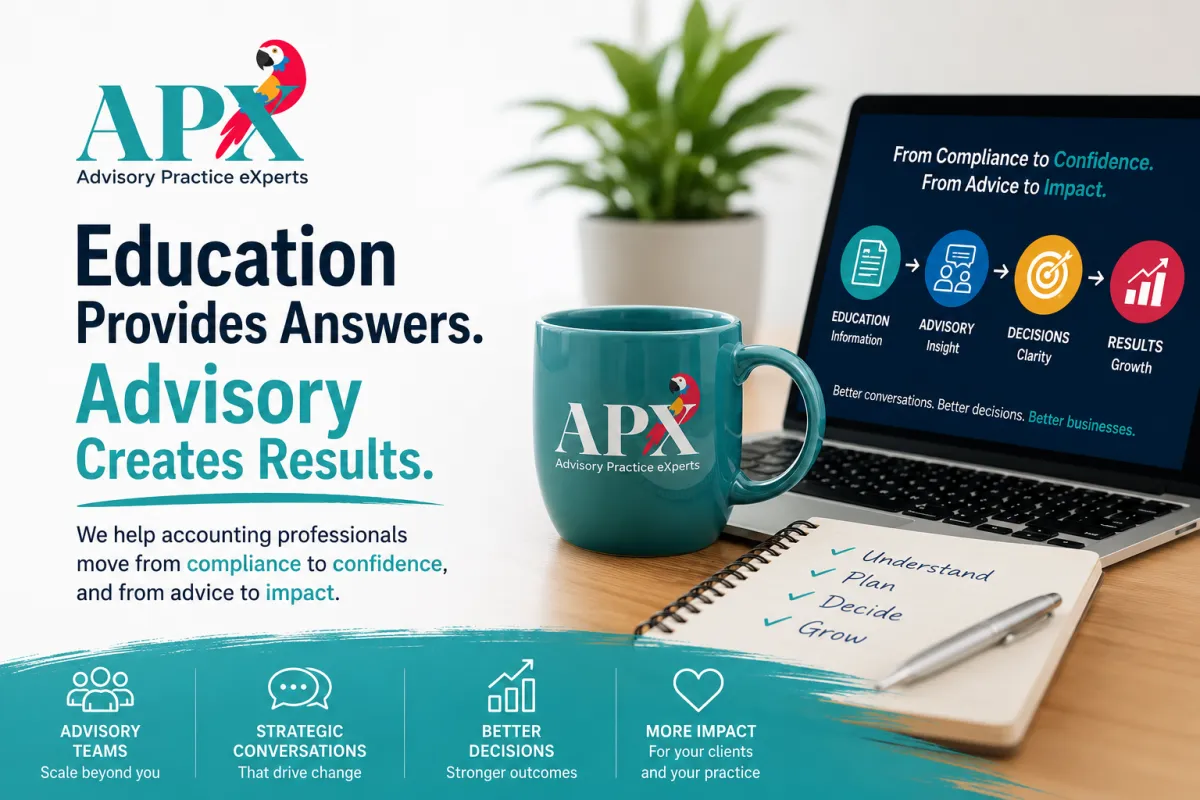
Education Isn't Advisory. And Mixing Them Up Is Costing You Time.
Education Isn't Advisory. And Mixing Them Up Is Costing You Time.
There is a question that almost every accountant, bookkeeper and advisor eventually asks themselves.
"Why do I keep answering the same questions over and over again?"
The same conversation.
The same explanation.
The same email.
The same phone call.
Different client.
Exactly the same question.
If you've ever felt like you have a little parrot sitting on your shoulder repeating the same conversations every week, you're not alone.
The problem isn't your clients.
The problem is that many of us haven't clearly separated education from advisory.
And that distinction changes everything.
What Is Education?
Education is information that is useful to many people.
It's generally:
Repetitive
Generic
Reactive
The same answer regardless of who asks the question
Questions such as:
What expenses can I claim?
How does VAT work?
What's the difference between salary and dividends?
What records should I keep?
How do I register as an employer?
These are valuable questions.
But they're educational questions.
The answer is often the same whether you're speaking to one client or one hundred.
What Is Advisory?
Advisory is different.
Advisory is:
Proactive
Bespoke
Strategic
Focused on outcomes and decisions
Questions such as:
Should I employ someone this year?
Can I afford to increase my salary?
Why is cashflow becoming tighter?
Is now the right time to invest in growth?
What would happen if I increased prices by 10%?
There is no generic answer to these questions.
The answer depends entirely on the individual business, the business owner and their goals.
That's advisory.
The Hidden Trap
The challenge is that educational questions often lead directly into advisory conversations.
A client asks:
"How much should I pay myself?"
The educational answer might be a discussion around tax efficiency and director remuneration.
But then comes the follow-up question:
"What should I pay myself?"
That's no longer education.
That's advisory.
Because now you're discussing personal goals, cashflow, profitability, future plans and business strategy.
You've moved from information into decision-making.
And very often, advisors make this transition without even noticing it.
Giving Away Advisory For Free
This is where many practices accidentally give away huge amounts of value.
A quick question turns into a twenty-minute conversation.
The conversation becomes strategic.
The client leaves with clarity, confidence and a plan.
The advisor moves onto the next task without ever recognising they have just delivered advisory.
Sound familiar?
The issue isn't generosity.
The issue is sustainability.
Because if every client interaction becomes free advisory, eventually capacity disappears.
Education Scales. Advisory Doesn't.
One of the biggest differences between education and advisory is scalability.
Education can be delivered once and used many times.
Videos.
Guides.
Courses.
Resource libraries.
FAQs.
Client portals.
The same answer can support hundreds of clients.
Advisory works differently.
Advisory requires conversations.
Judgement.
Context.
Understanding.
Human insight.
Education creates efficiency.
Advisory creates transformation.
Clients need both.
Building Better Systems
The practices that scale successfully tend to separate the two deliberately.
Educational content is captured and stored where clients can access it whenever they need it.
Advisory conversations are reserved for strategic sessions where they create the most value.
This benefits everyone.
Clients get faster answers.
Teams save time.
Advisors spend more time where they have the greatest impact.
And businesses become less dependent on answering the same questions repeatedly.
One Final Question
Once you understand the difference between education and advisory, another question naturally follows:
How are you moving into delivering more advisory for your clients?
Because recognising the difference is only the first step.
The real opportunity lies in building systems that allow education to scale, while creating the space for advisory conversations that genuinely change outcomes.
And that's where the future of our profession lies.


