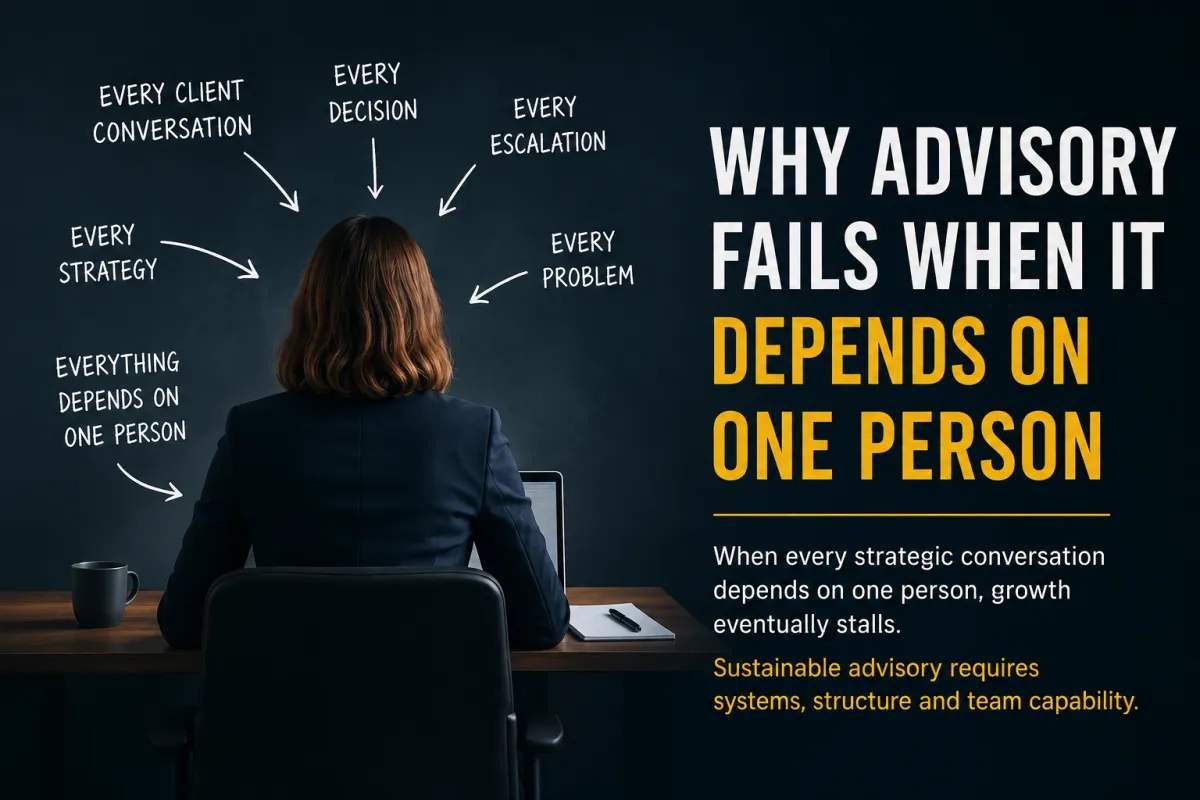
Why Advisory Fails When It Depends on One Person
Most accounting firms do not fail at advisory because they lack technical knowledge.
They fail because the entire advisory experience depends on one person.
Usually, that person is the practice owner.
At first, this does not feel like a problem. In fact, it often feels like success.
Clients want to speak directly to the founder. The founder understands the numbers. They know the client history. They can ask the right questions. They can spot opportunities quickly. Advisory meetings feel valuable because the founder is leading them personally.
But over time, the same thing that created growth becomes the very thing that limits it.
Every important client conversation ends up in one diary.
Every strategic decision depends on one brain.
Every escalation comes back to one person.
And eventually the practice hits a ceiling.
Not because the demand disappears.
Not because clients stop valuing advisory.
But because the business cannot scale around one individual.
The Hidden Problem Behind Most Advisory Models
Many firms believe they have an advisory offering when in reality they have a highly capable founder doing advisory work manually.
Those are not the same thing.
A true advisory business is not built around personality alone.
It is built around repeatable systems, frameworks, processes and team capability.
Without structure:
Team members lack confidence
Advisory quality becomes inconsistent
Clients receive different experiences
Capacity becomes unpredictable
Growth creates stress instead of freedom
The founder becomes the bottleneck.
The Difference Between Compliance and Advisory
Compliance work naturally evolved into systems over time.
Bookkeeping workflows.
VAT workflows.
Year-end workflows.
Payroll workflows.
These services became scalable because firms documented them, standardised them and trained teams to deliver them consistently.
Advisory often remains stuck in the founder’s head.
The conversations may feel natural, but without structure they are difficult to transfer to a team.
That is why many firms struggle to scale advisory beyond a handful of clients.
Why Clients Actually Want Structure
There is a fear many firms have when introducing advisory systems.
“If we standardise this, clients will feel like they are being processed.”
In reality, the opposite is usually true.
Clients value clarity.
They want:
predictable outcomes
clear meeting structures
accountability
confidence
momentum
measurable progress
Structure does not remove the human side of advisory.
It protects it.
When the process is clear, the advisor can focus more fully on listening, leading and supporting the client.
The Shift From Founder-Led to System-Led
The firms that successfully scale advisory make an important transition.
They stop asking:
“How do I personally deliver more advisory?”
And start asking:
“How do we build a business capable of delivering advisory consistently?”
That shift changes everything.
It leads to:
advisory frameworks
team training
documented processes
meeting structures
client journeys
accountability systems
leadership development
This is where advisory becomes sustainable.
Building an Advisory Business That Scales
If advisory depends entirely on the founder, growth eventually becomes exhausting.
But when advisory is supported by systems and delivered through a capable team, the practice becomes more valuable, more scalable and far less dependent on one individual.
That is the future many firms are now moving towards.
Not advisory as an additional service.
But advisory as an operational model.
And the firms that solve the bottleneck problem early will have a significant advantage over the next decade