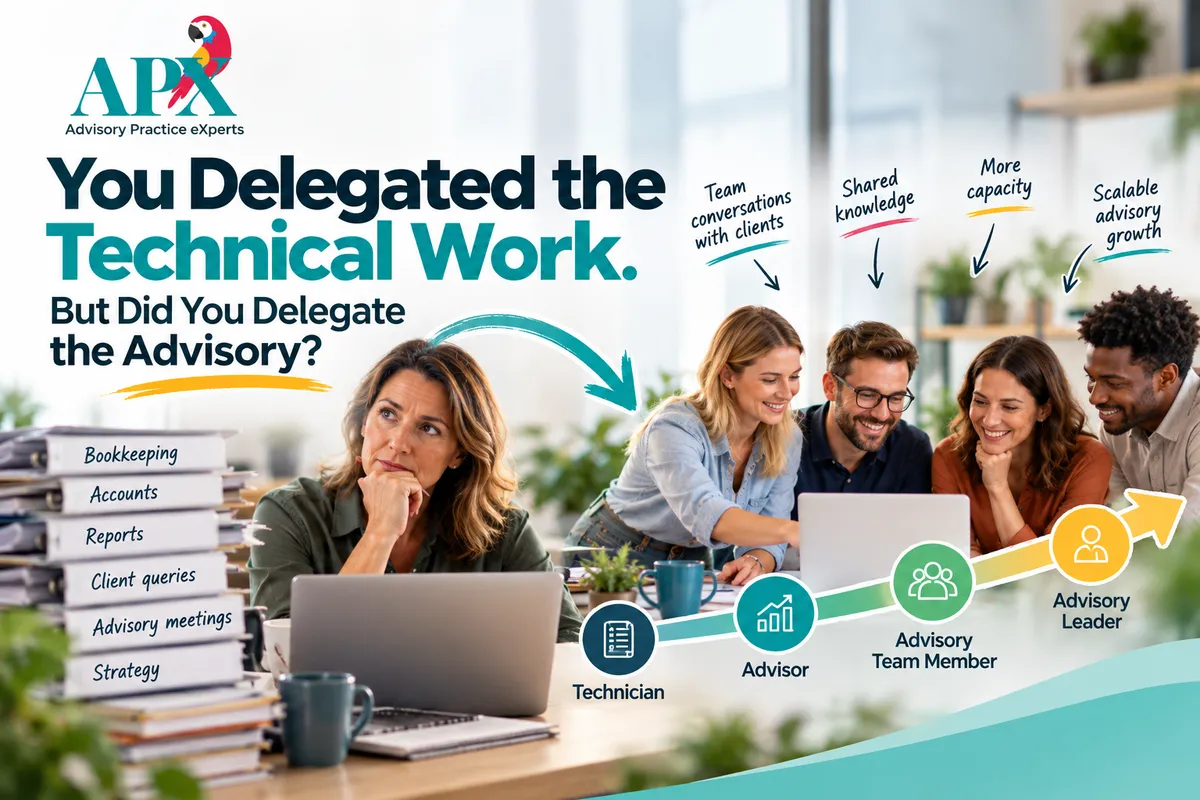
You Delegated the Technical Work. But Did You Delegate the Advisory?
You Delegated the Technical Work. But Did You Delegate the Advisory?
What if growing your advisory service didn't mean putting more work on the practice owner?
It sounds obvious. Growth shouldn't automatically mean more work for one person.
Yet it's a pattern we see repeatedly in accounting and bookkeeping practices.
A practice decides it wants to do more advisory work.
The owner recognises that spending their time completing technical work isn't the best use of their experience, so they begin to delegate.
Bookkeeping moves to the team.
Accounts production moves to the team.
Management information and reporting move to the team.
The owner gets more time back.
And that time is used to work more closely with clients.
On the surface, it looks like the perfect solution.
Except there's a problem.
The practice may have delegated the technical work, but it hasn't necessarily delegated the advisory capability.
The work has changed. The dependency hasn't.
Once the owner has more time available, they can have deeper conversations with clients.
They help clients understand their numbers.
They discuss cash flow, profitability, pricing, growth and other financial strategies.
They become increasingly involved in business decisions.
Clients value those conversations, so the advisory service grows.
But who is delivering it?
Usually, it's still the owner.
More advisory clients mean more meetings for them.
More questions come to them.
More decisions need their input.
More client relationships depend on them.
Eventually, the diary starts filling up again.
The owner has successfully delegated one type of work, only to replace it with another.
The work has changed. The dependency hasn't.
And that's where advisory can become difficult to scale.
Delegation isn't the same as capability building
There's an important distinction between delegating work and developing capability.
Delegation asks:
"What work can I give to somebody else?"
Capability building asks:
"What does my team need to learn so they can take greater ownership?"
Those are very different questions.
If your team produces all the information but every important conversation still comes back to you, the business remains dependent on you.
If your team prepares management accounts but you're the only person who can interpret them with the client, the advisory capability still sits with you.
If your team identifies a potential cash flow problem but needs you to decide what happens next, you're still part of every process.
That might be appropriate while somebody is developing.
The problem comes when there's no pathway for that person to progress beyond it.
Your team can do more than free you up
One of the biggest shifts in building an advisory team is changing how you think about the role of your people.
Your team shouldn't exist simply to take lower-value work away from you so that you can do the higher-value work.
They can become part of delivering that value too.
That doesn't mean suddenly asking a technician to take responsibility for a complex strategic client relationship.
Capability develops progressively.
A technician might start by learning to identify what the numbers are telling them.
Then they can begin explaining those observations.
Next, they can contribute to a client conversation.
They might learn one financial strategy and become confident discussing it with clients.
Over time, they can take responsibility for more of the advisory relationship.
One conversation. One strategy. One step at a time.
That's very different from throwing somebody in at the deep end and hoping they'll become an advisor.
From individual advisor to advisory team
Developing individual advisors is important, but there's another stage too.
People need to learn how to deliver advisory together.
That means sharing knowledge rather than keeping expertise with one person.
It means having consistent processes so the quality of the client experience doesn't depend entirely on who happens to be delivering it.
It means creating opportunities for less experienced team members to learn alongside those with more experience.
And it means recognising that different people can contribute different strengths to the same client relationship.
Advisory then stops being something that belongs to one individual.
It becomes a team capability.
Leadership changes too
This also changes the role of the practice owner or advisory leader.
Leadership isn't about remaining the person with all the answers.
It's about developing other people so they become increasingly capable of finding those answers, having those conversations and taking ownership themselves.
That requires a deliberate approach to development.
People need opportunities to practise.
They need frameworks and processes they can follow.
They need feedback.
They need confidence.
And they need somebody willing to gradually let go.
The aim isn't to remove the owner from advisory altogether.
The owner may still be involved in particular clients, complex situations or strategic conversations where their experience adds value.
The difference is that the entire advisory service no longer depends on them.
Having an advisor isn't the same as building an advisory team
There's a significant difference between having an advisor in your practice and building an advisory team.
If the owner is the advisor, you have advisory expertise.
If several individuals can independently advise clients, you've expanded that expertise.
But when people across the practice understand how they contribute, collaborate effectively and can progressively develop their advisory capability, you've started building something much more scalable.
That's the thinking behind the APX development pathway:
Technician → Advisor → Advisory Team Member → Advisory Leader
The objective isn't simply to free the practice owner up to do more advisory.
It's to build the skills, confidence, financial understanding, processes and leadership capability that allow advisory to be delivered across the practice.
Because your team can be much more than the people who free you up to do the valuable work.
They can be part of delivering that value too.
And that's how you begin moving advisory beyond the owner and building a practice that isn't dependent on one person.
Build the capability. Build the team. Remove the bottleneck.
Find out more about how APX develops advisory capability across accounting and bookkeeping practices at apxtraining.co.uk.


