The Bottleneck Problem: Why Advisory Fails When it Depends on One Person
The Bottleneck Problem: Why Advisory Fails When It Depends on One Person
There is a pattern that plays out in accounting practices all over the UK. A practice owner successfully introduces advisory services. Client relationships improve. Fees increase. The work becomes more meaningful. Everything looks like it is working.
And then growth stops.
Not because the service is poor. Not because the clients are not engaged. But because every advisory conversation, every strategic meeting, every major client decision depends on one person , the practice owner.
This is the bottleneck problem. And it is not unique to advisory. It is the central challenge of every service business that grows beyond its founder's capacity to deliver everything personally.
How It Develops
The bottleneck rarely appears suddenly. In the early stages of introducing advisory, it makes complete sense for the practice owner to lead every strategic conversation. They have the experience, the client relationships, and the confidence. Advisory conversations that start with the founder feel natural , and they deliver results.
But as the practice grows, the same dynamic that created early success begins to limit what is possible. Every advisory client needs the owner available. Every strategic meeting is in the owner's diary. Every significant recommendation requires their sign-off.
What began as a high-value service has become a new type of compliance trap — just with bigger numbers.
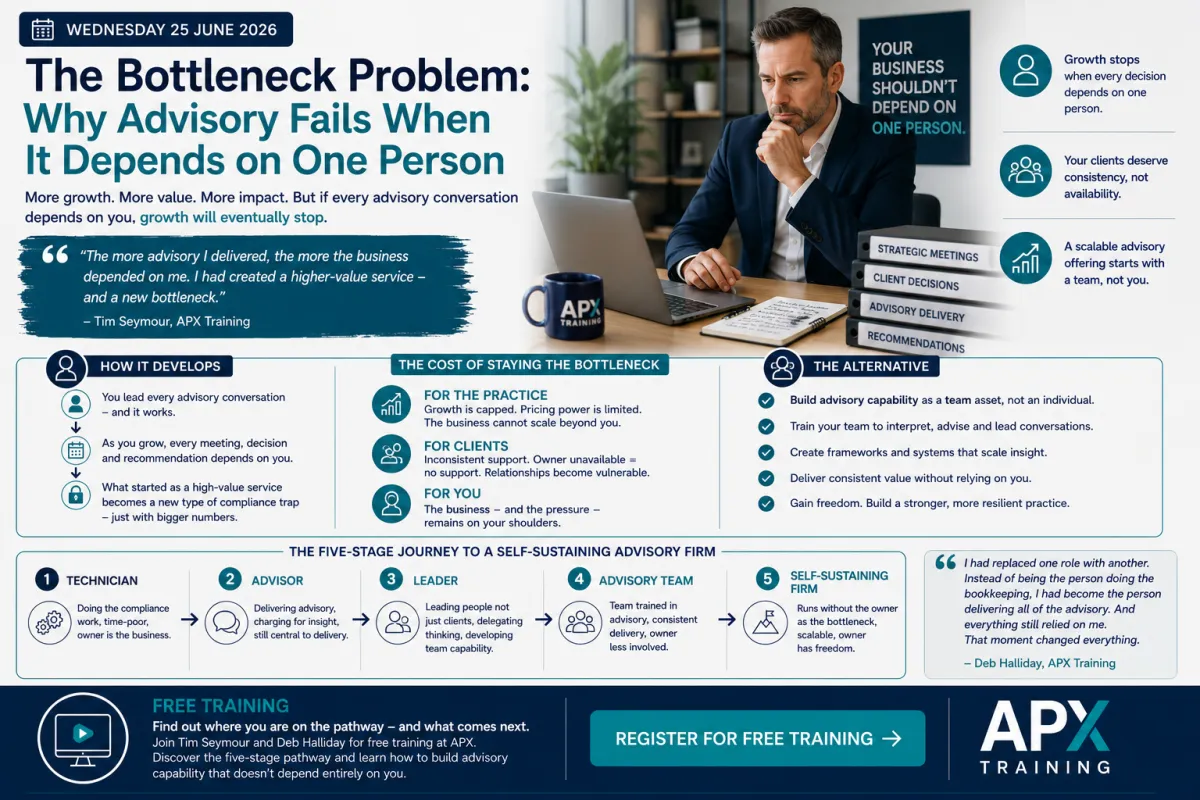
"The more advisory I delivered, the more the business depended on me. I had created a higher-value service — and a new bottleneck." — Tim Seymour, APX Training
Why This Is Fundamentally Different From Compliance
Compliance work can be systematised. With the right processes, team members and technology, compliance tasks can be distributed, standardised and delivered consistently without the practice owner's direct involvement in every client file.
Advisory has traditionally resisted this kind of systematisation , because most practices treat it as a personality-led service rather than a process-led one. When advisory lives entirely in the founder's head, it cannot scale. When it is built into structured frameworks, trained into a team, and delivered through consistent processes, it can.
This distinction - between personality-led advisory and process-led advisory -is the core of what APX Training was built to solve.
The Cost of Staying the Bottleneck
The consequences of owner-dependent advisory extend beyond growth limitations. They affect the sustainability of the practice, the experience of clients, and the wellbeing of the practice owner.
For the practice, capacity is artificially capped. No matter how strong the team, the business cannot take on more advisory clients than the owner can personally serve. Pricing power is also limited , because the service is perceived as access to one individual rather than access to a firm's capability.
For clients, owner-dependent advisory creates inconsistency. If the owner is unavailable, support disappears. If the owner eventually steps back from the business, client relationships built on personal connection become vulnerable.
For the practice owner, the personal cost is often the most acute. Deb Halliday, co-founder of APX Training, describes her own experience: "I had replaced one role with another. Instead of being the person doing the bookkeeping, I had become the person delivering all of the advisory. And everything still relied on me. That moment changed everything , because I realised advisory, if built around one person, doesn't scale."
What the Alternative Looks Like
The practices that solve the bottleneck problem share a common characteristic: they treat advisory capability as a team asset rather than an individual one.
This means training team members not just to produce financial information, but to interpret it. It means giving team members the frameworks, the language and the structured support to contribute to client conversations, and gradually to lead them. It means creating systems that allow advisory insights to flow through an organisation rather than sitting with one person.
The result is a practice that can grow beyond the owner's personal capacity. Client relationships become stronger because multiple people understand the strategic direction of each business. The practice becomes more resilient because knowledge is shared rather than concentrated. And the practice owner gains something they often started the journey to find, genuine freedom from the day-to-day.
The Five-Stage Journey
At APX Training, we map the journey from technician to self-sustaining advisory firm across five stages:
Technician— doing the compliance work, time-poor, owner is the business
Advisor— delivering advisory, charging for insight, still central to delivery
Leader— leading people not just clients, delegating thinking, developing team capability
Advisory Team— team trained in advisory, consistent delivery, owner less involved
Self-Sustaining Firm— runs without the owner as the bottleneck, scalable, owner has freedom
Most practices that introduce advisory reach Stage 2 and stop. The bottleneck is not a failure of ambition — it is a failure of structure. With the right training, the right frameworks and the right approach to team development, Stages 3, 4 and 5 are entirely achievable.
Advisory is not the end goal. Building a business that can deliver advisory without you is.
Deb Halliday
Free Training
Find out where you are on the pathway — and what comes next.
Join Tim Seymour and Deb Halliday for free training at APX. Discover the five-stage pathway and learn how to build advisory capability that doesn't depend entirely on you.


