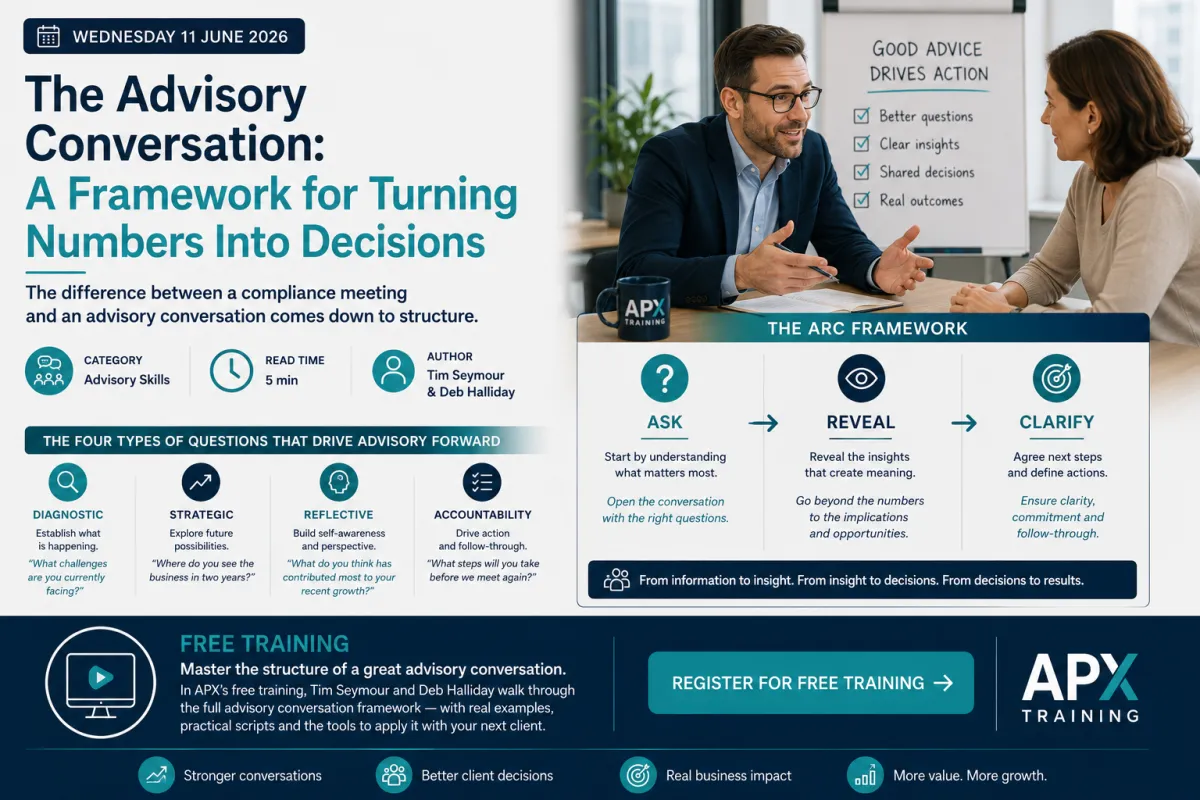
Advisory Conversation: A framework for turning numbers into decisions
The Advisory Conversation: A Framework for Turning Numbers Into Decisions
Most accounting client meetings follow a familiar pattern. Financial results are reviewed. Reports are discussed. Questions are answered. The meeting ends. The client leaves with accurate information and a vague sense that something useful happened.
And then nothing changes.
Not because the information was wrong. Not because the accountant lacked expertise. But because information, on its own, does not drive decisions. Meaning does. And the gap between information and meaning is exactly where advisory conversations live.
What Makes an Advisory Conversation Different
The difference between a compliance meeting and an advisory conversation is not primarily about what is discussed. It is about what the conversation is designed to achieve.
A compliance meeting is designed to deliver accurate information. An advisory conversation is designed to produce a decision, or the clarity needed to make one. Everything about how the conversation is structured, opened, navigated and closed flows from that distinction.
Technicians report the numbers. Advisors help clients decide what to do about them.
The ARC Framework
One of the most practical structures for advisory conversations is the ARC framework, Ask, Reveal, Clarify. It is simple enough to use in any meeting, flexible enough to adapt to any client situation, and powerful enough to transform the dynamic of a client relationship.
Ask— The most common mistake in advisory conversations is going straight to the findings. The advisor has reviewed the numbers, identified the patterns, prepared the insights, and is ready to present. But the client has not yet been asked what matters most to them right now. Starting with Ask means opening space for the client to share their current priorities, concerns and goals , in their own words, before you say anything about the data.
This changes everything. The analysis you deliver lands differently when it has been framed by what the client has just told you they care about. And occasionally, asking first reveals that the most important issue is not the one you prepared for.
Reveal— This is where the financial insight lives. But the key word is reveal, not report. Reporting tells the client what happened. Revealing tells the client what it means.
The practical difference is this: "Your costs have risen sixteen percent" is a report. "Your costs have risen sixteen percent, which means your margins have compressed from thirty-two to twenty-seven percent, and at this trajectory you will need to review your pricing structure before the end of the quarter" is a revelation. One invites a nod. The other invites a conversation.
Clarify— Advisory conversations that end without clear, specific next steps are advisory conversations that produce no change. Clarify is the step most often rushed or skipped, particularly when a meeting has run long or the conversation has been difficult. But it is the step that determines whether the advisory work you have done translates into real outcomes for the client.
Clarifying means confirming shared understanding of what has been discussed, agreeing specific actions with named owners and defined timelines, and confirming when those actions will be reviewed. "Let me know how you get on" is not a next step. "You will review your three largest supplier contracts by the end of the month and bring the findings to our next session on the fifteenth" is.
The Four Types of Questions That Drive Advisory Forward
Most advisory conversations rely almost entirely on diagnostic questions — questions that uncover facts and establish the current situation. These are essential, but they are only one type of question available to an advisor.
Diagnostic questions establish what is happening: "What challenges are you currently facing with cash flow?"
Strategic questions open up future possibilities: "Where do you see the business in two years, and what would need to change to get there?"
Reflective questions build self-awareness: "What do you think has contributed most to the growth you have seen this quarter?"
Accountability questions drive action: "What specific steps will you take before we meet again, and what might get in the way?"
A conversation that moves through all four question types is one that leaves the client genuinely thinking, not just informed. And a client who is thinking is one who acts.
Preparation Is Where Advisory Conversations Are Won
The quality of an advisory conversation is largely determined before it begins. Preparation is not reviewing the numbers , it is understanding the client's priorities, identifying the one or two most significant patterns in the data, and deciding which questions will move the conversation forward most usefully.
Going into a meeting to "discuss the accounts" is compliance thinking. Going in with a clear sense of what you want the client to understand, decide and commit to by the end of the session is advisory thinking. That preparation takes time. But it is the time that generates the most client value, and commands the most advisory fee.
Free Training
Master the structure of a great advisory conversation.
In APX's free training, Tim Seymour and Deb Halliday walk through the full advisory conversation framework, with real examples, practical scripts and the tools to apply it with your next client.


