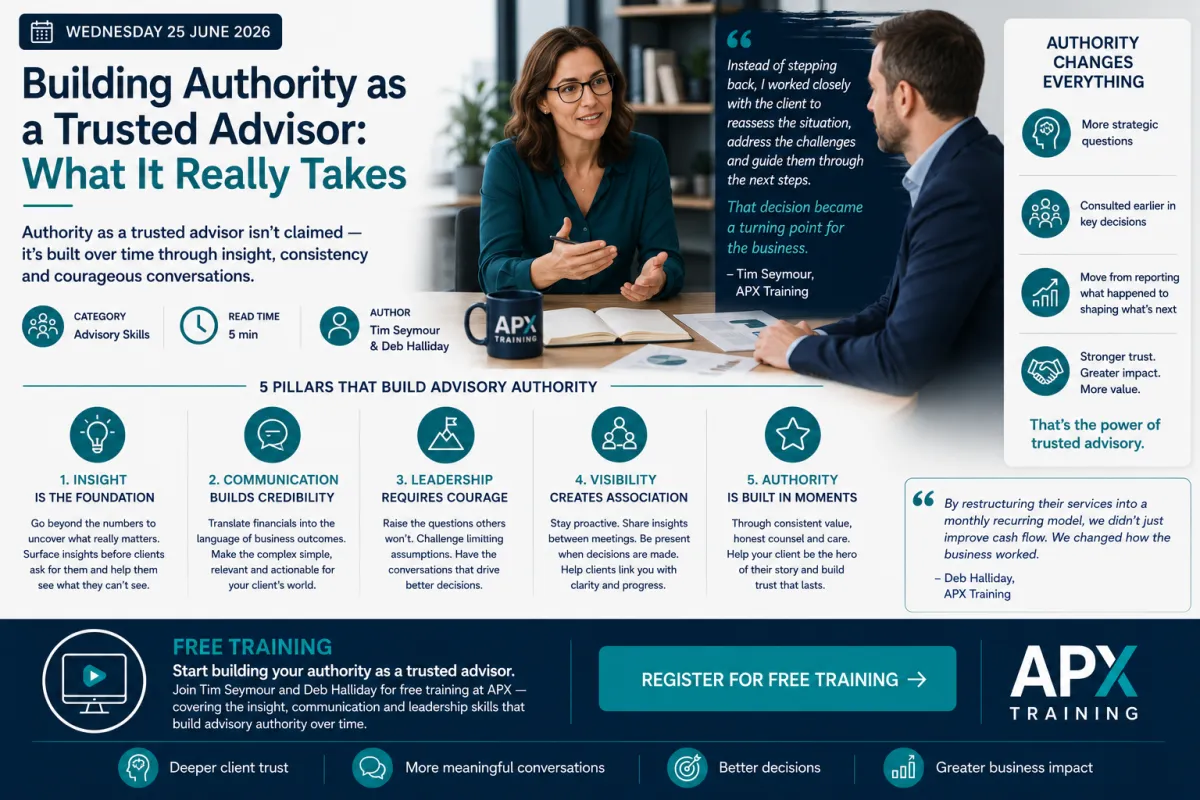
Building Authority as a Trusted Advisor
Building Authority as a Trusted Advisor: What It Really Takes
The shift from compliance accountant to trusted advisor does not happen automatically. Many practitioners assume that once they start offering advisory services, clients will immediately begin to see them differently. In practice, the transition requires something deeper , and something that cannot be shortcut.
It requires authority. And authority, in the context of advisory, is not something you claim. It is something that builds over time through the quality of your insight, the clarity of your communication, and the courage to say things that are genuinely useful even when they are not comfortable.
What Authority Actually Means
Authority in an advisory relationship is not about seniority or credentials. It is about being recognised as someone whose insight genuinely carries weight , whose perspective changes how a client thinks about a problem, and whose involvement in a decision makes that decision more likely to be a good one.
When clients see their advisor as a trusted authority, the dynamic of the relationship changes fundamentally. Questions become more strategic. The advisor is consulted earlier in major decisions. The conversation moves beyond reporting what happened to shaping what comes next.
This is the advisory relationship at its most valuable, for both the client and the practice.
Insight Is the Foundation
The most powerful way to build advisory authority is through the quality of insight delivered in client conversations. Clients already expect their accountant to understand financial data. What they value far more, and what distinguishes a trusted advisor from a capable technician, is the ability to interpret what that data means.
Why are margins changing? Where is profitability being lost? Which operational decisions are having the most significant financial consequences? When advisors consistently surface these insights, particularly before clients have asked for them — clients begin to see them differently.
Instead of the person who prepares their reports, the advisor becomes the person who helps them understand what those reports reveal. That shift in perception is often the moment an advisory relationship deepens into genuine partnership.
Communication Builds Credibility
Technical expertise, on its own, does not build advisory authority. Communication does.
Business owners do not think in accounting terminology. They think in outcomes — revenue growth, profitability, financial security, strategic direction. Advisors who translate financial information into the language of business outcomes — who make the numbers mean something in the context of what the client is trying to build — become far more valuable than those who stay in technical language.
This is not simplification. It is translation. The depth of the analysis remains unchanged. What changes is how that depth is communicated — in a way that is accessible, relevant and actionable for someone whose primary job is running a business, not reading accounts.
Leadership Requires Courage
Authority also grows through leadership — and advisory leadership requires a specific kind of courage.
Tim Seymour, co-founder of APX Training, describes working with a client who needed to secure finance to move into larger premises. The initial attempt did not go to plan, and the opportunity was at risk. "Instead of stepping back," Tim explains, "I worked closely with the client to reassess the situation, address the challenges, and guide them through the next steps. Eventually the finance was secured and the move went ahead. That decision became a turning point for the business."
What made the difference was not technical knowledge. It was trust — built through consistent presence, honest counsel and a willingness to stay engaged when things became difficult.
Advisors who lead well are sometimes required to raise questions their clients have not yet considered. To challenge assumptions that are limiting the business. To say clearly that a decision is risky when it is, even if that message is unwelcome. These conversations, handled with professionalism and genuine concern for the client's success, are what transform an advisor from a service provider into a trusted voice.
Visibility Creates Association
Authority is also influenced by presence. In many practices, accountants and bookkeepers do exceptional work behind the scenes and remain largely invisible to their clients between meetings. Advisory work requires a different level of engagement.
Clients associate their advisor with clarity, direction and progress when they see the advisor actively contributing — not just responding to requests. Regular proactive communication, sharing insights between formal meetings, and being available when decisions need to be made all strengthen the association between the advisor and the sense of confidence clients feel about their business.
Deb Halliday, co-founder of APX Training, developed her advisory authority in part by building a network of specialist relationships across different industries. "Working with a landscaping business revealed a common challenge," she explains. "They were charging by the hour, which limited growth and created seasonal fluctuations in cash flow. By restructuring their services into a monthly recurring model, we didn't just improve cash flow. We changed how the business worked." Insights like this — drawn from experience across sectors — significantly increase the breadth of value an advisor can bring to any single client conversation.
Authority Is Built in Moments
The deepest advisory authority does not come from a single impressive recommendation. It comes from an accumulation of moments — conversations where the client felt genuinely understood, decisions where the advisor's guidance made a real difference, difficult discussions where honesty and care were held together.
The most important thing to understand about building advisory authority is that it is not positioned. It is demonstrated. And the most powerful way to demonstrate it is not by positioning yourself as the expert. It is by helping your client become the hero of their own story — by making the decisions that move their business forward with greater clarity and confidence than they would have had without you.
That is what trusted advisory looks like in practice. And it is what every practitioner who commits to the journey is capable of building.
Free Training
Start building your authority as a trusted advisor.
Join Tim Seymour and Deb Halliday for free training at APX — covering the insight, communication and leadership skills that build advisory authority over time.