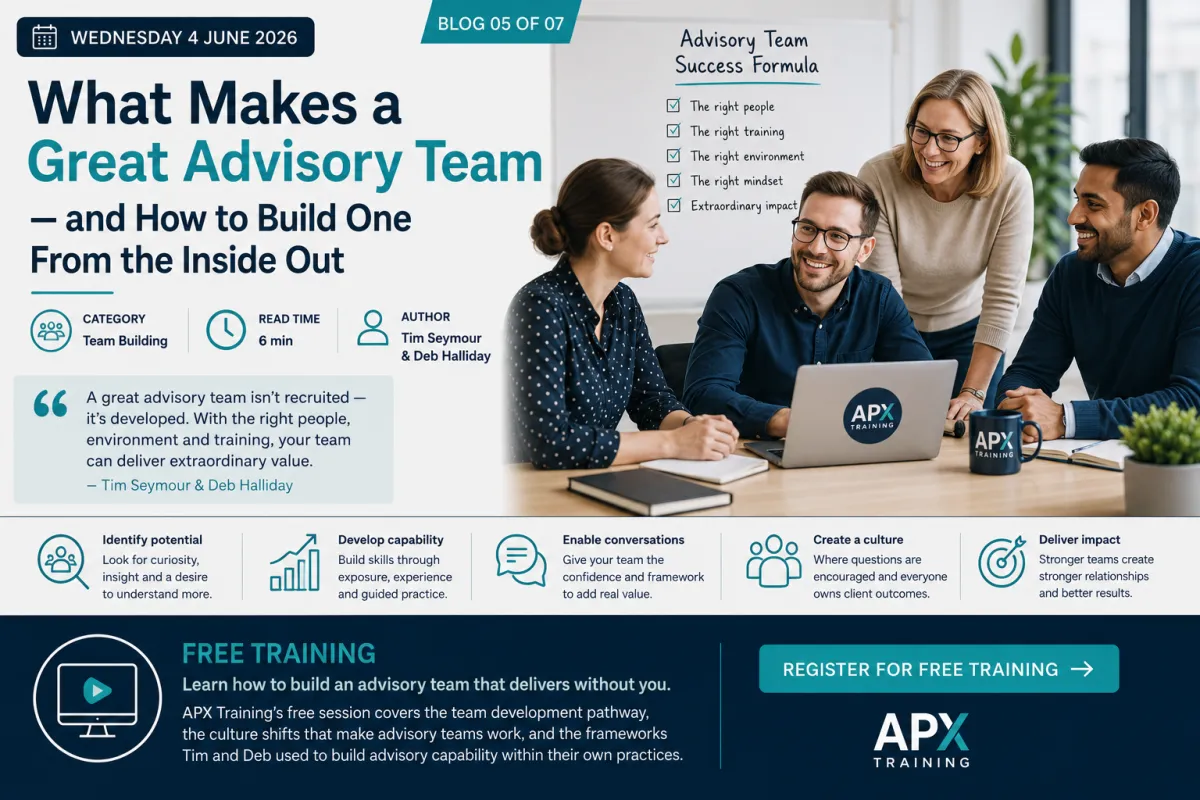
What Makes a Great Advisory Team
What Makes a Great Advisory Team — and How to Build One From the Inside Out
When practice owners think about building an advisory team, the instinct is often to look outwards. To recruit someone with advisory experience. To hire a business development specialist. To bring in an external consultant who already knows how to have strategic conversations with clients.
This instinct is understandable. But in most cases, it is also unnecessary, and it misses a far more powerful opportunity.
The strongest advisory teams are not assembled from the outside. They are developed from within , by identifying the right people, creating the right environment and providing the right training.
What Advisory Teams Actually Do Differently
Every accounting practice has a team. But not every team operates as an advisory team. The difference is not seniority or qualification level. It is orientation.
A compliance-oriented team focuses on completing tasks accurately and efficiently. Work flows through a process. Deadlines are met. Reports are produced. This is valuable, but it is fundamentally backward-looking. It tells clients what happened.
An advisory-oriented team thinks differently about the same information. When a bookkeeper notices an unusual pattern in day-to-day transactions, they flag it. When an accountant reviews a set of management accounts, they ask not just whether the numbers are right but what they mean for the client's next decision. When a team member sits in a client meeting, they contribute insight rather than just presence.
This shift does not require new people. It requires a new culture , and the training to make that culture real.
The People to Look For
Not every team member will naturally move into an advisory role, and not every role within a practice requires it. Some individuals find deep satisfaction in technical precision, and that expertise is essential to a well-run firm.
The people with the most advisory potential are usually identifiable by their curiosity. They ask why decisions are being made, not just what the figures show. They show interest in the client's business context. They begin connecting financial data to operational outcomes. They are often the team members who ask the most questions in a debrief, and whose questions tend to be strategic rather than technical.
"Not every team member will naturally step into an advisory role. Some show curiosity about the wider business context. They ask why decisions are being made. They show interest in client strategy. They begin to connect financial data with operational outcomes." — Advisory Teams, Tim Seymour & Deb Halliday
Identifying these individuals early and investing deliberately in their development is one of the highest-return actions a practice owner can take.
How Development Actually Works
Advisory capability is not built through instruction alone. It is built through exposure, experience and reflection.
The most effective development pathway for aspiring advisors within a practice follows a natural progression. Team members begin by observing strategic client conversations, sitting in on meetings alongside the senior advisor, absorbing the structure, the questions, the dynamics. Over time, they contribute, initially with specific pieces of financial insight they have prepared in advance. Eventually, they begin leading sections of conversations themselves.
This progression builds confidence gradually and sustainably. The team member develops their own advisory style through practice rather than theory. And critically, the practice owner is never removed from the loop too quickly, the transition happens at a pace that serves both the team member and the client.
What Deb Learned Building Her Team
Deb Halliday, co-founder of APX Training, sold her award-winning accounting practice to her team in 2025 , a transition that was only possible because she had spent years developing advisory capability within that team.
One of her most significant team development outcomes was a team member who joined at twenty-three and went on to win the AAT Practice of the Year Award. "She wasn't hired with advisory experience," Deb explains. "She was trained, supported and given the space to develop it. That's the model. You build the capability from the inside."
Deb's background in training and development, before she entered the accounting profession, shaped her approach fundamentally. She built structured learning pathways, created clear frameworks for client conversations, and gave team members the tools and the confidence to use them. The result was a practice that could deliver advisory without Deb being in every room.
The Culture That Makes It Work
Technical skills and structured processes are necessary but not sufficient. What brings an advisory team to life is culture, specifically, a culture where asking questions is encouraged, sharing insights is expected, and contributing to client outcomes is seen as every team member's role, not just the practice owner's.
Creating this culture starts with how the practice leader shows up. When team members see that their observations are valued, their questions welcomed and their development actively supported, confidence grows quickly. When they see the opposite, that advisory conversations are reserved for senior people and that raising strategic questions is overstepping, it contracts just as quickly.
Building an advisory team is ultimately a leadership challenge. The technical side can be trained. The culture has to be created deliberately, and it starts with the practice owner deciding that advisory capability belongs in the whole team, not just at the top.
Free Training
Learn how to build an advisory team that delivers without you.
APX Training's free session covers the team development pathway, the culture shifts that make advisory teams work, and the frameworks Tim and Deb used to build advisory capability within their own practices.