Why Your Clients Agree In The Meeting And Do Nothing Afterwards
Why Your Clients Agree in the Meeting and Do Nothing Afterwards
It is one of the most common frustrations among accountants and bookkeepers who have moved into advisory. The conversation goes well. The client engages. They nod at the recommendations. They say yes. They leave apparently convinced.
And at the next meeting, nothing has changed.
This pattern , agreement without action, is not a client problem. It is a conversation structure problem. And understanding why it happens is the first step to preventing it.
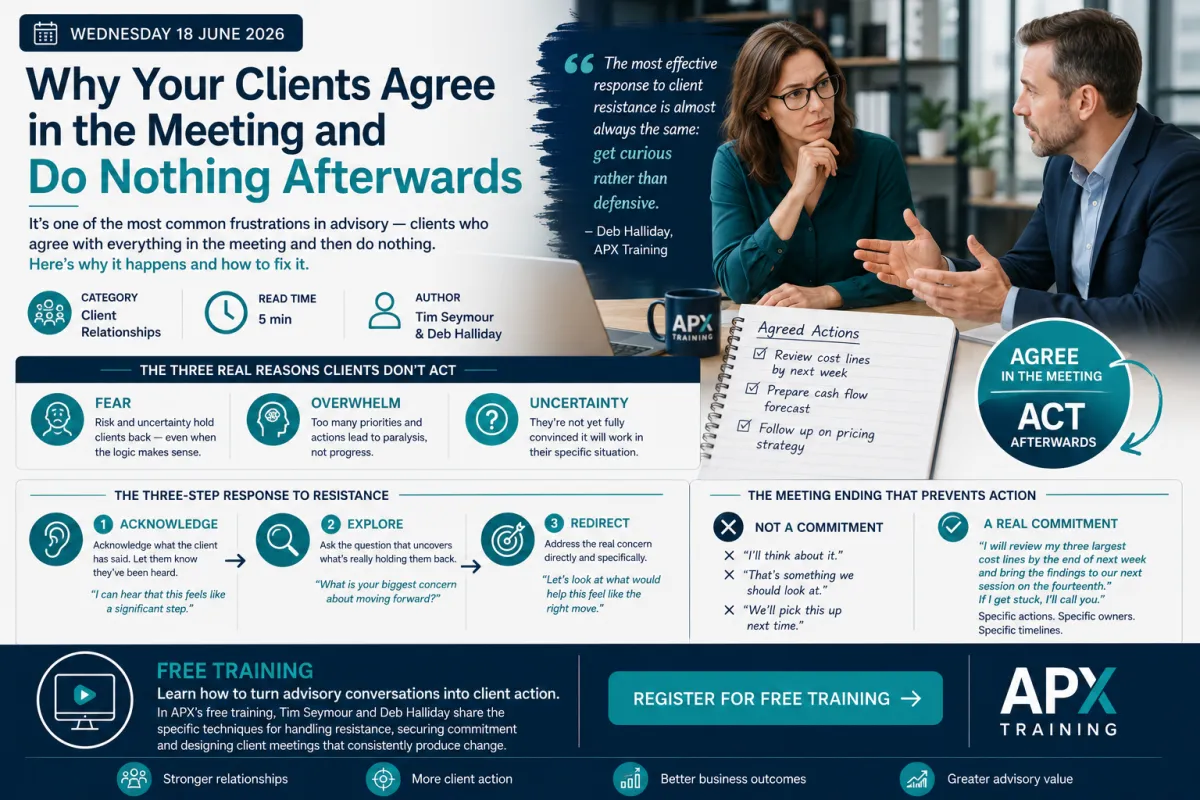
The Three Real Reasons Clients Don't Act
When clients fail to follow through on advisory recommendations, the natural assumption is that they didn't really believe the advice, or didn't value it enough to act. In most cases, neither is true.
The three most common real reasons are far more straightforward.
Fear: Business decisions carry risk, and business owners often feel that risk acutely. The bigger the recommended change, the bigger the fear attached to it. Even when the logic of the advice is clear and the data is compelling, the emotional weight of making a significant decision can freeze a client in place. They agreed in the meeting because they understood the argument. They did nothing afterwards because fear won.
Overwhelm. Advisory conversations can cover significant ground. A client who leaves a meeting with three priorities, four action points and five things to think about is not energised — they are overloaded. When everything feels important, nothing gets done. The paralysis that looks like disengagement is often simply a response to too much being asked at once.
Uncertainty. Even when a client trusts their advisor and agrees with the recommendation, they may not yet fully believe it will work in their specific situation. This is not scepticism about the advisor's expertise. It is the natural caution of someone who has to live with the consequences of the decision in a way the advisor does not.
Why the Instinct to Justify Is the Wrong Response
When a client pushes back, or when an advisor senses that the recommendation has not fully landed, the natural instinct is to justify. To present more evidence. To make a stronger case. To add another argument to the pile.
This instinct is understandable. And in almost every case, it makes things worse.
More justification signals that the advisor is not confident in what they said. It can make the client feel pressured rather than supported. And it moves the conversation from collaboration to persuasion, a dynamic that rarely produces genuine commitment.
"The most effective response to client resistance is almost always the same: get curious rather than defensive. What's your biggest concern about moving forward? That one question does more to advance an advisory relationship than any counter-argument." — Deb Halliday, APX Training
The Three-Step Response to Resistance
The framework that consistently works is built on curiosity rather than advocacy.
Acknowledge. Before doing anything else, acknowledge what the client has said — without agreeing or disagreeing with it. "I can hear that this feels like a significant step." This tells the client they have been heard, which is often the most important thing an advisor can offer in a moment of resistance.
Explore. Ask the question that uncovers what is actually holding them back. Not "do you understand the recommendation?", that can feel condescending. But "what is your biggest concern about moving forward?" or "what would need to be different for this to feel like the right move?" These questions reveal the real objection, which is frequently different from the stated one.
Redirect. Once the real concern is visible, address it directly and specifically. This is often where the most valuable advisory work happens, not in the preparation or the presentation of findings, but in the patient navigation of a client's genuine hesitation.
The Meeting Ending That Prevents Action
There is another structural reason clients fail to act after advisory meetings — one that is entirely within the advisor's control. Most meetings end without clear, specific commitments.
"I'll think about it" is not a commitment. "That's something we should look at" is not a commitment. "We'll pick this up next time" is not a commitment.
A commitment sounds like: "I will review my three largest cost lines by the end of next week and bring the findings to our next session on the fourteenth. If I get stuck, I'll call you."
The difference between these two endings is not the quality of the advisory conversation that preceded them. It is the five minutes at the end where specific actions, specific owners and specific timelines are agreed and written down before the meeting closes.
Advisory that does not end in clear action is advisory that will not be valued — because without visible outcomes, clients begin to wonder what they are paying for. The structured meeting close is not administrative tidiness. It is where advisory value is either secured or surrendered.
Free Training
Learn how to turn advisory conversations into client action.
In APX's free training, Tim Seymour and Deb Halliday share the specific techniques for handling resistance, securing commitment and designing client meetings that consistently produce change.